(Alan Berliner; USA)
Quietly remarkable and devastating. The subject of the documentary, Edwin Honig, is fully within the grip of Alzheimers, and yet what is compelling is his lucidity in the face of a failing memory. A poet and translator, he still playfully engages in conversation while admitting that his memory has disappeared into 'a long endless thing.' Berliner breaks up the film by combining and tightly editing all conversations he had with his cousin, creating a simulation of sorts of memory itself. The recollection of conversations with others are often recalled not in chronological sequence, but in a fragmented re-ordered narrative that is never quite the same each time. Clearly the parallels between memory and film are obvious, but Berliner does a great justice to his film by not heavy-handedly jamming this to the forefront of its themes. The ides of this film, or film in general, as an archive or repository for memory resides in the margins, a quiet reflection that hums gently throughout as we see repeated shots of Honig grappling with the poet he used to be and that he no longer seems to be able to access. His past now a strange story belonging to someone else, Honig is horrifyingly aware of what has been 'killed off' inside of him.
Yet, this is not a maudlin or weep-inducing portrait of an illness. For starters, stories of Honig's failings as a husband and father slowly unfold through the course of the film, inducing an emotional distance from the man. But what really makes the film transcendent is how Berliner's own curiosity and observation bleed through the film and infect the viewer. Rather than aiming for the cheap emotional weight of the debilitating aspects of Alzheimers, Berliner desires to understand how memory loss affects one's humanity, how one remains a human while undergoing a gradual erosion of potentially all that makes up one's life. It is this deep and quiet curiosity that makes the film so rich and engaging.

Sunday, 4 August 2013

THE END OF TIME
(Peter Mettler; Canada/ Switzerland)
Starting with Joseph Kittinger's 31km skydive in 1960, this film moves gracefully from meditating upon the Hadron Collider, lava flows in Hawaii and the decaying city of Detroit, in order to muse upon the nature, perception and meaning of time.
In this meandering essay, time is viewed as inextricably intertwined with space, matter, death, and the mind, but Mettler does not simply jam together a gloriously haphazard collections of thoughts and images. In the final section of the film, it seems as if Mettler is folding all previous themes and images in the film into each other, creating a temporal palimpsest, a non-linear and looping exposition on time.
Beautifully shot (Mettler is majestic behind the camera - watch his 1994 film Picture of Light to see what I mean), and replete with geometric patterns, natural flows (wind, lava, sea, clouds) and quiet repose, this film is a delightful warm bath for the eyes.
But, as well as being visually rapturous, Mettler urges your mind to tick over, mulling on your own personal relationship to time, dwelling upon the mystery of your own life, long after you've walked out of the cinema.
Starting with Joseph Kittinger's 31km skydive in 1960, this film moves gracefully from meditating upon the Hadron Collider, lava flows in Hawaii and the decaying city of Detroit, in order to muse upon the nature, perception and meaning of time.
In this meandering essay, time is viewed as inextricably intertwined with space, matter, death, and the mind, but Mettler does not simply jam together a gloriously haphazard collections of thoughts and images. In the final section of the film, it seems as if Mettler is folding all previous themes and images in the film into each other, creating a temporal palimpsest, a non-linear and looping exposition on time.
Beautifully shot (Mettler is majestic behind the camera - watch his 1994 film Picture of Light to see what I mean), and replete with geometric patterns, natural flows (wind, lava, sea, clouds) and quiet repose, this film is a delightful warm bath for the eyes.
But, as well as being visually rapturous, Mettler urges your mind to tick over, mulling on your own personal relationship to time, dwelling upon the mystery of your own life, long after you've walked out of the cinema.
Saturday, 3 August 2013
VIOLA
(Matias Pineiro; Argentina)
Pineiro is the new magician of talk-addicted film. Comparisons to the films of John Cassavetes are obvious, and probably occur with frequency, but the comparisons are perhaps apt. The pace, rhythm, and fire of talk and chat in Cassavetes' films urges intense focus, and the same holds true for Pineiro.
There is wit, deftness, clever puzzle-logic, and hidden layers to the barrage of words that abound in Viola, and this web of words creates a wonderful tension, a sense of not having firm footing, a feeling of constantly slipping. Not so much a feeling of losing a hold of the plot, but in not even knowing where the plot begins or ends.
This verbal trickery is wondrously matched by Pineiro's camera-work - by constantly focussing on faces, we lose grasp of surroundings and thus lose a grasp of whether a given moment is reality, dream, performance, or some odd limbo between all three.
In mastering this combination of verbal chicanery and tightly-framed cinematography, Pineiro has achieved more in 63 minutes than most directors can do in 120.
Pineiro is the new magician of talk-addicted film. Comparisons to the films of John Cassavetes are obvious, and probably occur with frequency, but the comparisons are perhaps apt. The pace, rhythm, and fire of talk and chat in Cassavetes' films urges intense focus, and the same holds true for Pineiro.
There is wit, deftness, clever puzzle-logic, and hidden layers to the barrage of words that abound in Viola, and this web of words creates a wonderful tension, a sense of not having firm footing, a feeling of constantly slipping. Not so much a feeling of losing a hold of the plot, but in not even knowing where the plot begins or ends.
This verbal trickery is wondrously matched by Pineiro's camera-work - by constantly focussing on faces, we lose grasp of surroundings and thus lose a grasp of whether a given moment is reality, dream, performance, or some odd limbo between all three.
In mastering this combination of verbal chicanery and tightly-framed cinematography, Pineiro has achieved more in 63 minutes than most directors can do in 120.
Friday, 2 August 2013
EXPERIMENTAL SHORTS @ MIFF 2013
How the hell am I going to do this? Reviewing 10 short films in 15 minutes?
SECOND SUN (Joel Stern/ Pia Borg; Australia/ UK)
Angry screaming mega-pixels. Like a stroppy, industrial Jordan Belson in an arcade parlour. Not bad, actually.
WANTEE (Laure Provost; UK)
Nope. Nope. Nope.
THE STREAM 3 (Hiroyuki Sakurai: Japan)
Simple, short, shot on an iPhone, drizzly, stuck in a pipe, meh.
BY PAIN AND RHYME AND ARABESQUES OF FORAGING (David Gatten; USA)
Oh, yes, now THIS was the whole reason for being here. Soft, diaphanous, scrawling and trawling through text, grasping some but never all, the whole a blissful mystery but so beguiling.
IYEZA (Kudzanai Chiurai; South Africa)
It'd make a great music video. But ultra slo-mo as the be-all-and-end-all of the piece doesn't really cut the mustard for me.
RECONNAISANCE (Johann Lurf; Austria)
Wonderfully simple, yet by the end of this 5 minute piece, there's an odd sense of not being entirely certain of what you've seen. Ostensibly this appears to be various shots of a decommissioned torpoedo-site, but unless I was going nuts it seems that there was more to this than expected. Still haunting my head.
DOUBLE GRAFFITI (Paul Winkler; Australia)
A genuine revelation here. Shot on 16mm, this film is a flicker-fest of constantly-rotating segments of graffiti-laden wall. The familiarity of tags is channeled into a intense new landscape of constant motion. Rather mesmeric.
DAD'S STICK (John Smith;UK)
A paean to his dead father, through the objects his father obsessively re-used. Smith's humour surprisingly rarely grates, and this becomes a moving piece on familial bonds through the quotidian objects.
CRYSTAL WORLD (Pia Borg; Australia/ UK)
Trying to do too many things. If the film focussed purely on the crystallisation process of underwater figures and objects, the film may have been stronger. Including segments from Night Of The Hunter seemed to throw it off balance.
...BECAUSE SUPERGLUE IS FOREVER! (Johan Grimonprez; Belgium)
I'm not sure that this worked. I think I expected something tighter from Grimonprez. The collation of news items, re-used footage, and news stories, etc read/ played by two young girl felt a little like a haphazard collision of ideas - an archival version of throwing everything at the wall and hoping it will stick.
SECOND SUN (Joel Stern/ Pia Borg; Australia/ UK)
Angry screaming mega-pixels. Like a stroppy, industrial Jordan Belson in an arcade parlour. Not bad, actually.
WANTEE (Laure Provost; UK)
Nope. Nope. Nope.
THE STREAM 3 (Hiroyuki Sakurai: Japan)
Simple, short, shot on an iPhone, drizzly, stuck in a pipe, meh.
BY PAIN AND RHYME AND ARABESQUES OF FORAGING (David Gatten; USA)
Oh, yes, now THIS was the whole reason for being here. Soft, diaphanous, scrawling and trawling through text, grasping some but never all, the whole a blissful mystery but so beguiling.
IYEZA (Kudzanai Chiurai; South Africa)
It'd make a great music video. But ultra slo-mo as the be-all-and-end-all of the piece doesn't really cut the mustard for me.
RECONNAISANCE (Johann Lurf; Austria)
Wonderfully simple, yet by the end of this 5 minute piece, there's an odd sense of not being entirely certain of what you've seen. Ostensibly this appears to be various shots of a decommissioned torpoedo-site, but unless I was going nuts it seems that there was more to this than expected. Still haunting my head.
DOUBLE GRAFFITI (Paul Winkler; Australia)
A genuine revelation here. Shot on 16mm, this film is a flicker-fest of constantly-rotating segments of graffiti-laden wall. The familiarity of tags is channeled into a intense new landscape of constant motion. Rather mesmeric.
DAD'S STICK (John Smith;UK)
A paean to his dead father, through the objects his father obsessively re-used. Smith's humour surprisingly rarely grates, and this becomes a moving piece on familial bonds through the quotidian objects.
CRYSTAL WORLD (Pia Borg; Australia/ UK)
Trying to do too many things. If the film focussed purely on the crystallisation process of underwater figures and objects, the film may have been stronger. Including segments from Night Of The Hunter seemed to throw it off balance.
...BECAUSE SUPERGLUE IS FOREVER! (Johan Grimonprez; Belgium)
I'm not sure that this worked. I think I expected something tighter from Grimonprez. The collation of news items, re-used footage, and news stories, etc read/ played by two young girl felt a little like a haphazard collision of ideas - an archival version of throwing everything at the wall and hoping it will stick.
DIFFERENTLY, MOLUSSIA
(Nicholas Rey: France)
I saw this last year, but not on the big screen, so to see it blown up big and proud is just one hell of an experience. This is truly Cinema. Shot in 16mm, which is touted by Rey in a trailer for his film as a dying medium, this exquisite film revels in own divine self. The grit, grain, pockmarks are all so alive - crunchy, gritty, it makes the film a truly haptic, synaesthetic experience.
This is kind of fake-ethnographic film, a faux documentary of a world called Molussia. The camera spins on a number of occasions, shaking up the actual world being filmed - the recognisable fields, streets, houses, workers - and inverting it, making it another world. With sporadic commentary, derived from Gunther Anders book The Molussian Catacomb, interspersed over the shots of fields, seas, workers, it becomes believable that the places we see, the workers we see, all belong to the fictional City of Molussia.
The soundtrack often splinters, shreds, disintegrates into crackling shards. It sounds like cinema eating itself. Or as if this film is actually trying to form itself, make itself out of itself.
This is an utterly epiphanous film that keeps singing and resounding long after it is finished. I could watch it again and again and again. I could watch it at least 362,880 times, to be precise.
I saw this last year, but not on the big screen, so to see it blown up big and proud is just one hell of an experience. This is truly Cinema. Shot in 16mm, which is touted by Rey in a trailer for his film as a dying medium, this exquisite film revels in own divine self. The grit, grain, pockmarks are all so alive - crunchy, gritty, it makes the film a truly haptic, synaesthetic experience.
This is kind of fake-ethnographic film, a faux documentary of a world called Molussia. The camera spins on a number of occasions, shaking up the actual world being filmed - the recognisable fields, streets, houses, workers - and inverting it, making it another world. With sporadic commentary, derived from Gunther Anders book The Molussian Catacomb, interspersed over the shots of fields, seas, workers, it becomes believable that the places we see, the workers we see, all belong to the fictional City of Molussia.
The soundtrack often splinters, shreds, disintegrates into crackling shards. It sounds like cinema eating itself. Or as if this film is actually trying to form itself, make itself out of itself.
This is an utterly epiphanous film that keeps singing and resounding long after it is finished. I could watch it again and again and again. I could watch it at least 362,880 times, to be precise.
COMING FORTH BY DAY
(Hala Lotfy; Egypt/ UAE)
Fascinating fiction feature debut from this Egyptian filmmaker. A full day is marked out in the life of a mother and daughter tending to their ailing husband/father, but it is the slow torpor of caregiving and the quiet pressures it exerts that breathes wonderful life to the pace, rhythm and texture of this film. In an ever-increasing world of 'slow cinema', Lotfy makes a deep and rich impression by allowing plenty of time for the characters to reveal their life, their world purely when glancing at another, or most crucially when lost in thought.
Bold compositions, with remarkable interior shots set with angular crisp lines, and rich earthy tones - from sun-up to sepia-tinged sun-down, the film is bled into browns, greys, beige, murky white.
The final third of the film, while perhaps not as striking in visual tone to the earlier interior sequences in the home, is the most ensnaring part, as we see the daughter quietly undergoing a midnight revelation in private, moving from some kind of misguided selfishness to a deeper place of quiet repose, a place we can nearly surmise but not quite. We can read her thoughts, but can we really?
Fascinating fiction feature debut from this Egyptian filmmaker. A full day is marked out in the life of a mother and daughter tending to their ailing husband/father, but it is the slow torpor of caregiving and the quiet pressures it exerts that breathes wonderful life to the pace, rhythm and texture of this film. In an ever-increasing world of 'slow cinema', Lotfy makes a deep and rich impression by allowing plenty of time for the characters to reveal their life, their world purely when glancing at another, or most crucially when lost in thought.
Bold compositions, with remarkable interior shots set with angular crisp lines, and rich earthy tones - from sun-up to sepia-tinged sun-down, the film is bled into browns, greys, beige, murky white.
The final third of the film, while perhaps not as striking in visual tone to the earlier interior sequences in the home, is the most ensnaring part, as we see the daughter quietly undergoing a midnight revelation in private, moving from some kind of misguided selfishness to a deeper place of quiet repose, a place we can nearly surmise but not quite. We can read her thoughts, but can we really?
Thursday, 1 August 2013
MIFF 2013
Once upon a time I used to gorge myself silly on film during the Melbourne International Film Festival. For the past couple of years this has reduced to a tiny morsel, as fatherhood has imposed new routines and schedules. However, this year I'm hoping to pop along to at least ten films, maybe more, we'll just see how lucky I get with my time.
As I'm in a new realm of having to be very very picky about what I choose to see, I'm opting, for the most part, for films that have not, and most likely will not, receive future distribution in Australia. Being extremely selective is proving to be an unusually rewarding experience, learning to sift and sift again through the possible selections to find films most enriching to my little ol' soul.
As part of a promise I've kept, I'm going to write a brief review of each film seen. Well, 'review' is not really the right word - the aim is to write up any thoughts, feelings, lack of feelings, etc, on the film just seen - the review has to be no more than 200 words, must be completed within the day it is seen, and must be completed in ten minutes. If this doesn't happen, I'm doing the dishes every day for a month.
Right, better get cracking...
As I'm in a new realm of having to be very very picky about what I choose to see, I'm opting, for the most part, for films that have not, and most likely will not, receive future distribution in Australia. Being extremely selective is proving to be an unusually rewarding experience, learning to sift and sift again through the possible selections to find films most enriching to my little ol' soul.
As part of a promise I've kept, I'm going to write a brief review of each film seen. Well, 'review' is not really the right word - the aim is to write up any thoughts, feelings, lack of feelings, etc, on the film just seen - the review has to be no more than 200 words, must be completed within the day it is seen, and must be completed in ten minutes. If this doesn't happen, I'm doing the dishes every day for a month.
Right, better get cracking...
Tuesday, 15 January 2013
Top 10 Films of 2012
(It took forever to get this post finished. I was worried 2013 would finish before I got this 2012 wrap-up done. Hastily written at any spare moment, I’m just happy that this little list actually exists, regardless of whether it makes sense or not. Also, yay to me for breaking a 5-month freeze on this blog by actually posting something. Is the blog officially unfrozen? I’d like to say yes, but I’ve made loads of promises that have not come to fruition in the past, so let’s say for now it’s still thawing.)
If 2011 saw a distinct drop in the number of films viewed, then in 2012 this pace dropped to a near standstill. What else could be expected with bringing up a new baby, undergoing a complete vocational about-face, and taking on full-time study as well as full-time work? I’m happy I got the occasional dollop of sleep last year, let alone the chance to watch a few films here and there.


There’s an intense complexity woven within this film’s
fabric that is belied by the simplicity of an unrequited love story. Dream
interpretation, story-telling, and re-living memories are recurring motifs that
elide the two-part structure of the film. While initially feeling rigid and
clinically precise, the film slips and melts with graceful sensuality. And, at
its beating heart, the film aches for cinema’s own history, yearning for its
own paradise lost.
8. STUDENT (Darezhan Omirbayev; Kazakhstan)

Omirbayev should be far more well-known than he is. This
somewhat faithful rendering of Dostoevsky’s Crime
and Punishment sets the story in modern-day Kazakhstan as a means to
critique the soul-less modernisation of his country. Although Bresson appears
to be an obvious influence, the close-ups, gestures and quiet pace accumulate
to form Omirbayev’s own signature which reflects the friction between the old
socialist version of Kazakhstan and the new capitalist version. While the film
may be bleak and unemotional, it is also extremely elegant and precise. It also
has the simplest yet quietly haunting dream sequence I’ve seen in a long time.

Embedding his ‘Maddin-esque’ style deep within the noir genre possibly makes for Maddin’s
most accessible work yet. However, ‘accessible’ and ‘Maddin’ don’t exactly live
on the same street, and this ties genre conventions in knots from the outset.
Ostensibly the film focuses on a gangster boss and his mob returning to his
family home to hole up for a while, in hiding from the police. However, the
home is haunted, not just with yelling ghosts, but with memories, and boss
appears to be committed to nothing other than working out how to remember his
past through navigating not just the labyrinth of the house but the layers of
memory that still live and breathe within its walls. Here, there does not
appear to be mere life and death, or the living and the ghost traces of the
dead, but instead a multitude of blurred varieties of mortality. Mundane
objects take on a powerful resonance, as placement and movement trigger memory.
The protagonist’s own being seems to ultimately be infused with the house, and
the film projects not just a poetics of memory but also a poetics of space.

Grant Gee’s film is an attempt to mirror W.G. Sebald’s
‘unclassifiable’ book The Rings Of Saturn,
ostensibly a travelogue of the writer’s walk through Suffolk but also a meander
through his thoughts on European history, literature, and culture. To do this,
the film becomes almost book-like, with grainy images of many places along the
route taken by Sebald indexed with a page number. The film thus becomes a
travelogue of a travelogue, making a map of the book as much as mapping the
places described within the book. The layered quality of Sebald’s work is
emulated through an accretion of overlapping layers to the images – shots of quiet
and lonely landscapes are inlaid with text, fading images of interviewees,
pages from the book itself. And, at last, someone has the sense to score an
entire film with music by The Caretaker – the ghostly sounds of records from
yesteryear seem to perfectly match the spectral grainy tone of the film.

This is a deceptive documentary that transcends a mere portrait
of the Russian art collective Voina. Gryazev apparently infiltrated the group
and recorded their exploits in 2010. These exploits and actions at first appear
to be utterly childish – organised shop-lifting and turning over cars make the
group appear to be less of an art collective and more a bunch of immature
pranksters using the ‘art’ tag to justify larking about. Constant bickering
between the leaders, Oleg Vorotnikov and his partner Natalia Sokol, doesn’t
help this initial impression. However, slowly the film reveals the group’s
plans and plots to be far more cohesive than it first appears, and it leads to
an organised action that has serious consequences for the group. As the film
progresses, and the group are targeted for criminal conduct, a deep complexity arises
in relating to these protagonists. On the one hand, having warmed to over the
course of the film, it is easy to feel concerned, perhaps even outraged, at
their plight. On the other hand, there is an ever-increasing concern that the
leaders are putting their politics and art before being a cohesive family. Their
18-month old son is a strong focus of the film, and may possibly even be the
motive behind its title, questioning the ‘tomorrow’ of this boy’s future. Although
the leaders are depicted as loving parents, the exposure of this child to their
antics is questionable (especially at the climax of the film, where the boy is
present at a Voina-instigated riot, and potentially exposed to physical harm). The
incremental movement of this film from its first impressions to deeply conflicted
and unsettled feelings towards Voina make for an unusually powerful film that
stays with you long after it is over.
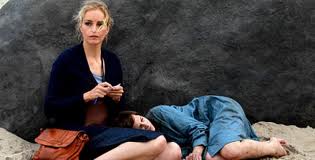
There is not a single superfluous moment in this film.
Petzold has sculpted a lean, poised, and simmering work that is capable of
exercising powerful contradictions. East Germany in the 1980’s is visually presented
as bleak, cold, and clinical, but also replete with visual warmth, colour and softness.
The eponymous protagonist vacillates from aloof to abrasive to cordial to
vulnerable and then back again. Within an economically spare visual framework
and script, Petzold has performed some kind of magic to engineer a constant
push-and-pull of emotional attachment, while steadily tightening the tension to
near vice-like proportions.
3. THE LONELIEST
PLANET (Julia Loktev; USA/ Germany)

The most devastating split second on film in 2012. This
blink-and-you-miss-it decision ruptures the supposed harmony between an engaged
couple travelling through the Caucasus Mountains, but what makes the film so powerful
is through showing this rupture via wordless treks, haunted expressions, and floundering
gestures of rapprochement and mitigation. Loktev opts for having the characters
thoughts and emotions locked deep inside their heads, withdrawing them to the
loneliest place from each other but also allowing the viewer to make a deeper ‘there-but-for-the-grace-of-God’
connection. Because of this very spartan approach, this film is possibly the
most tragic portrait of relationship to hit the screen in a long, long time.

From out of nowhere, Carax pulls out his best and wildest
film ever. This is a love poem to cinema’s own history, a vehicle for Denis
Lavant’s powers of performative commitment and self-transformation, and a spectral
journey through the streets of Paris all rolled into one. But there’s more, so
much more. The act of performing takes on an incrementally elegiac tone, with
Lavant getting wearier with each appointment. Is it the weight of expectation
from an unseen audience, the same audience watching a film (or watching us?) at
the beginning of this wild ride? You almost wonder if Lavant’s Mr. Oscar is
always aware that we are watching
him, that we demand these
appointments be kept. Carax seems to portray cinema itself as loaded down with
this heavy weight of demands and desires, and has attempted to craft a
magnificent vehicle to try and shuck off the weight and fly to freedom.

Rey’s full-length experimental masterpiece operates on totally different plane than any other film of 2012. Composed of 9 reels that can be played in any random order, it exists in a perpetual present, its trajectory never a foregone conclusion. This freedom seems to give the film a mesmeric quality. Rey’s work is an interpretation of a book he has never read (Gunther Anders’ 1936 novel The Molussian Catacomb), in a language he does not understand (German). Grainy and colour-drained footage of ploughed fields, sparse hills, highways, and industrial buildings are wedded with fragments from Anders’ book, but the spoken text is drizzled sporadically over the images, allowing for a hypnotic change in the way the landscape is viewed. The footage, derived from ‘our’ world, eerily becomes another world, the fictional city of Molussia. The novel’s dystopian city of the future is woven into our ‘now’, rendering time, history and verisimilitude as arbitrary concerns. This blending of contemporary Europe into fictional Molussia is almost hallucinatory, a vertiginous magic trick born from celluloidal grain and pockmarks. Truly spellbinding.
Monday, 20 August 2012
Experimental Films in the Sight and Sound Poll 2012

Having been housebound this past week, and having my desired
film festival attendance shattered, I have consoled myself in some small part
by trawling through the full kit-and-caboodle of the Sight and Sound 2012 Poll.
The list of the Top 250 films held brief interest, but it was trawling through
the full list of films voted that has held the greatest fascination. To flick
through the list and find utter obscurities, and then search for further info
on these unknown potential treasures has provided a nest of joy and comfort in
a current cinema-less phase. This, surely, is the true pleasure of these
meta-lists – to come across yet more films and more directors that are
completely unheard-of, then setting off in search of any scant information on
these films, and then setting off once more to find the actual film itself. My
personal list of ‘must-watch’ films gets more and more gargantuan by the hour.
Having a growing and abiding fascination for experimental
cinema, I have been especially interested to see how this has fared in the
polls. There has been a surprising quality and depth to the representation of
experimental cinema in the polls, with some filmmakers popping up with alarming
frequency (for example, Robert Beavers and Bruce Baillie have six films each on
the full poll list). It would have been grand to have had films by Lawrence Jordan, Gustav Deutsch, Martin Arnold, and
Lewis Klahr on the list, but perhaps if the pollsters had the opportunity to
draft up a list of 20 films rather than 10, the story would have been quite
different.
Born purely out of sheer curiosity, I have collated all of
the experimental films found in the full poll list, and you’ll find the
complete list of 127 films below. The list is not definitive, as there is a
likelihood I’ve accidentally skipped a film here and there in my trawl through
the poll list. But, hey ho, it’s good enough for now.
Update: 11 September 2012 = It's taken me a while but I've added the votes from the Directors polls, released by Sight and Sound on 22 August. Any odds and ends that I missed out first time around have also been included. I've added the votes together for the Critics and Directors. And here's the updated list:
Update: 11 September 2012 = It's taken me a while but I've added the votes from the Directors polls, released by Sight and Sound on 22 August. Any odds and ends that I missed out first time around have also been included. I've added the votes together for the Critics and Directors. And here's the updated list:
|
Chien Andalou, Un (1928) Luis Buñuel
|
24
|
|
Wavelength (1967) Michael Snow
|
19
|
|
Meshes of the Afternoon (1943) Maya
Deren, Alexander Hammid
|
17
|
|
Chelsea Girls (1966) Andy Warhol,
Paul Morrissey
|
9
|
|
Région Centrale, La (1971) Michael
Snow
|
7
|
|
Empire (1964) Andy Warhol
|
6
|
|
Outer Space (2002) Peter Tscherkassky
|
6
|
|
Aguaespejo granadino (1955) José Val
del Omar
|
5
|
|
Flaming Creatures (1963) Jack Smith
|
5
|
|
Mothlight (1963) Stan Brakhage
|
5
|
|
Portrait of Ga (1952) Margaret Tait
|
5
|
|
Arnulf Rainer (1960) Peter Kubelka
|
4
|
|
As I Was Moving Ahead Occasionally I
Saw Brief Glimpses of Beauty (2000) Jonas Mekas
|
4
|
|
Unsere Afrikareise (1961) Peter
Kubelka
|
4
|
|
13 Lakes (2005) James Benning
|
3
|
|
Act of Seeing with One's Own Eyes,
The (1971) Stan Brakhage
|
3
|
|
Blue (1993) Derek Jarman
|
3
|
|
Hart of London, The (1970) Jack
Chambers
|
3
|
|
Line Describing a Cone (1973) Anthony
McCall
|
3
|
|
Little Stabs at Happiness (1963) Ken
Jacobs
|
3
|
|
Movie, A (1958) Bruce Conner
|
3
|
|
Report (1986) Bruce Conner
|
3
|
|
Schwechater (1958) Peter Kubelka
|
3
|
|
Too Early, Too Late (1982) Jean-Marie
Straub, Danièle Huillet
|
3
|
|
Walden: Diaries, Notes and Sketches
(1975) Jonas Mekas
|
3
|
|
Zorns Lemma (1970) Hollis Frampton
|
3
|
|
Valentin de las Sierras (1967) Bruce Baillie
|
3
|
|
(nostalgia) (1971) Hollis Frampton
|
2
|
|
Adebar (1957) Peter Kubelka
|
2
|
|
Anticipation of the Night (1958) Stan
Brakhage
|
2
|
|
Cosmic Ray (1962) Bruce Conner
|
2
|
|
"Diary" David Perlov
|
2
|
|
Ere erera baleibu icik subua aruaren
(1970) José Antonio Sistiaga
|
2
|
|
Free Radicals (1958) Len Lye
|
2
|
|
From the Notebook of… Robert Beavers
|
2
|
|
Girl Chewing Gum, The (1976) John
Smith
|
2
|
|
Human Remains (1998) Jay Rosenblatt
|
2
|
|
Images of the World and the
Inscription of the War (1988) Harun Farocki
|
2
|
|
Mass for the Dakota Sioux (1964)
Bruce Baillie
|
2
|
|
Outer and Inner Space (1965) Andy
Warhol
|
2
|
|
Rose Hobart (1936) Joseph Cornell
|
2
|
|
Ruskin (1974) Robert Beavers
|
2
|
|
Scorpio Rising (1964) Kenneth Anger
|
2
|
|
Screen Tests (1965) Andy Warhol
|
2
|
|
Trade Tattoo (1937) Len Lye
|
2
|
|
verifica incerta, La (1967) Alberto
Grifi, Gianfranco Baruchello
|
2
|
|
Way Things Go, The (1987) Peter
Fischli, David Weiss
|
2
|
|
Window Water Baby Moving (1959) Stan
Brakhage
|
2
|
|
1126 Dewey Avenue, Apt. 207 Creators
unknown
|
1
|
|
23rd Psalm Branch (1966) Stan
Brakhage
|
1
|
|
37/78 Tree Again (1978) Kurt Kren
|
1
|
|
Amor (2002) Robert Beavers
|
1
|
|
Arabesque (1929) Germaine Dulac
|
1
|
|
Assumption (1997) Peter Gidal
|
1
|
|
Ballet mécanique (1924) Fernand
Léger, Dudley Murphy
|
1
|
|
Beauty No 2 (1965) Andy Warhol
|
1
|
|
Begone Dull Care (1949) Evelyn
Lambart, Norman McLaren
|
1
|
|
Behindert (1974) Stephen Dwoskin
|
1
|
|
Birth of the Nation (1973) Klaus
Wyborny
|
1
|
|
Black TV Aldo Tambellini
|
1
|
|
Bleu Shut (1970) Robert Nelson
|
1
|
|
Blight John Smith
|
1
|
|
Bliss (1967) Gregory J. Markopoulos
|
1
|
|
Blow Job (1964) Andy Warhol
|
1
|
|
Carriage Trade (1967) Warren Sonbert
|
1
|
|
Casting a Glance (2007) James Benning
|
1
|
|
Castro Street (1966) Bruce Baillie
|
1
|
|
Clock, The Christian Marclay
|
1
|
|
Color of Love, The (1995) Peggy
Ahwesh
|
1
|
|
Colour Box, A (1935) Len Lye
|
1
|
|
Dots (1940) Norman McLaren
|
1
|
|
Dresden Dynamo (1971) Lis Rhodes
|
1
|
|
Egyptian Series Stan Brakhage
|
1
|
|
End, The (1953) Christopher Maclaine
|
1
|
|
Eniaios Gregory J. Markopoulos
|
1
|
|
Eureka (1983) Ernie Gehr
|
1
|
|
Exodus (1997) Steve McQueen
|
1
|
|
Fire in Castile (Tactil Vision of the
Wasteland of Fear) (1961) José Val del Omar
|
1
|
|
Flicker, The (1966) Tony Conrad
|
1
|
|
Fuses (1966) Carolee Schneemann
|
1
|
|
Gammelion (1968) Gregory J.
Markopoulos
|
1
|
|
Geschichte der Nacht (1978) Clemens
Klopfenstein
|
1
|
|
Gloria! Hollis Frampton
|
1
|
|
Ground, The (2002) Robert Beavers
|
1
|
|
Guns of the Trees (1961) Jonas Mekas
|
1
|
|
Hapax Legomena Hollis Frampton
|
1
|
|
Hardwood Process David Gatten
|
1
|
|
Himmler Project, The (2000) Romuald
Karmakar
|
1
|
|
Hold Me While I'm Naked (1966) George
Kuchar
|
1
|
|
Hours for Jerome I & II (1983)
Nathaniel Dorsky
|
1
|
|
In Girum Imus Nocte et Consumimur
Igni (1978) Guy Debord
|
1
|
|
Instructions for a Light and Sound
Machine (2005) Peter Tscherkassky
|
1
|
|
Invocation of My Demon Brother (1969)
Kenneth Anger
|
1
|
|
Kitch's Last Meal (1978) Carolee
Schneemann
|
1
|
|
Lamentations (1985) R Bruce Elder
|
1
|
|
Mirror Animations Harry Smith
|
1
|
|
My Hand Outstretched to the Winged
Distance and Sightless Measure Robert Beavers
|
1
|
|
Nicht löschbares Feuer (1968) Harun Farocki
|
1
|
|
One Way Boogie Woogie/27 Years Later
(2005) James Benning
|
1
|
|
Peggy and Fred in Hell (2002) Leslie
Thornton
|
1
|
|
Place of Work & Tailpiece
(1976) Margaret Tait
|
1
|
|
Poetic Justice (1972) Hollis Frampton
|
1
|
|
Presents (1981) Michael Snow
|
1
|
|
Quick Billy (1968) Bruce Baillie
|
1
|
|
Quixote (1964) Bruce Baillie
|
1
|
|
Rabbit's Moon (1950) Kenneth Anger
|
1
|
|
Rainbow Dance (1936) Len Lye
|
1
|
|
Reassemblage T. Minh-ha Trinh
|
1
|
|
Reel Time Annabel Nicolson
|
1
|
|
Renaissance (1963) Walerian Borowczyk
|
1
|
|
Revolver (1994) Jonas Odell, Stig
Bergkvist, Marti Ekstrand, Lars Olsson
|
1
|
|
Ritual in Transfigured Time (1946)
Maya Deren
|
1
|
|
RR (2008) James Benning
|
1
|
|
Seashell and the Clergyman, The
(1928) Germaine Dulac
|
1
|
|
Seasons of the Year, The (1975)
Artavazd Pelechian
|
1
|
|
Serene Velocity (1970) Ernie Gehr
|
1
|
|
Short Film Series Guy Sherwin
|
1
|
|
Shulie (1998) Elisabeth Subrin
|
1
|
|
Side/Walk/Shuttle Ernie Gehr
|
1
|
|
Sky Socialist, The Ken Jacobs
|
1
|
|
Society of the Spectacle, The (1973)
Guy Debord
|
1
|
|
Song and Solitude Nathaniel Dorsky
|
1
|
|
Star Spangled to Death (2003) Ken
Jacobs
|
1
|
|
Study of a River Peter Hutton
|
1
|
|
Tango (1980) Zbigniew Rybczynski
|
1
|
|
Text of Light (1974) Stan Brakhage
|
1
|
|
Textism Hirabayashi Isamu
|
1
|
|
To Parsifal Bruce Baillie
|
1
|
|
Trasferimento di modulazione Piero
Bargellini
|
1
|
|
vallée close, La (2000) Jean-Claude
Rousseau
|
1
|
|
Videograms of a Revolution (1993)
Harun Farocki, Andrei Ujica
|
1
|
|
Visions of Meditation Stan Brakhage
|
1
|
|
What Goes Up? Robert Breer
|
1
|
|
Wildfire (2003) Amy Greenfield
|
1
|
|
Wind Vane (1972) Chris Welsby
|
1
|
|
Work done Robert Beavers
|
1
|
|
Aerial (1974) Margaret Tait
|
1
|
|
Allures (1960) Jordan Belson
|
1
|
|
Anthem Apichatpong Weerasethakul
|
1
|
|
At Land (1944) Maya Deren
|
1
|
|
Capitalism: Slavery Ken Jacobs
|
1
|
|
Christmas on Earth (1963) Barbara
Rubin
|
1
|
|
Anemic Cinema 1926 Marcel Duchamp
|
1
|
|
Commingled Containers Stan Brakhage
|
1
|
|
Condition of Illusion (1975) Peter
Gidal
|
1
|
|
Couch (series) (1966) Andy Warhol
|
1
|
|
Crossroads (1976) Bruce Conner
|
1
|
|
Entr'acte (1924) René Clair
|
1
|
|
Light Reading (1979) Lis Rhodes
|
1
|
|
Long Film for Ambient Light Anthony
McCall
|
1
|
|
Lost Lost Lost (1975) Jonas Mekas
|
1
|
|
Ménilmontant (1926) Dimitri Kirsanoff
|
1
|
|
Nicht löschbares Feuer (1968) Harun
Farocki
|
1
|
|
Roh-Film (1968) Birgit and Willhelm Hein
|
1
|
|
Soft Fiction (1979) Chick Strand
|
1
|
|
Stadt in Flammen (1984) Schmelzdahin
|
1
|
|
Standard Gauge (1985) Morgan Fisher
|
1
|
|
Golfball - Ode to IBM Mara Mattuschka
|
1
|
|
Weather Diary 3 George Kuchar
|
1
|
|
Super Dyke Meets Madam X Barbara Hammer, Max Almy
|
1
|
|
Symbiopsychotaxiplasm: Take One
(1967) William Greaves
|
1
|
|
TV (1967) Kurt Kren
|
1
|
|
10 minutes older (1978) Frank Herz
|
1
|
|
2 minutes 45 seconds William Raban
|
1
|
Subscribe to:
Posts (Atom)